


Yehuda Saporta
Last Name: Saporta.
First Name: Yehuda.
Father's Name: Salvador.
Mother's Name: Buena.
Date Of Birth: 22/1/1938.
Place Of Birth: Salonika, Greece.
Current Adress: Kfar Saba.
Places:
Before The War:
Salonika, Greece
During The War:
Salonika, Greece
Bergen Belsen (Today: Lower Saxony)
Portbou Station (Bordered France and Spain)
After The War:
Barcelona, Spain
Qadis, Spain
Cazablanka, Morocco
Oran, Algeria
Naples
Port Said, Egypt
Nazareth Camp, Gaza
Palestine
Background Information
Before the holocaust
Sephardic Jewry
Many Sephardic Jews lived in Salonika, especially after 1492 when they were expelled from Spain and Portugal. The Turkish leaders at that time believed that Jewish population could have a positive effect on the local economy, and therefore welcomed them into the country.
The Sephardic Jews continued using Judo-Spanish, or Ladino, as their central language in both learning and common day life.
Religious Life
During the 16th through the 18th centuries, Salonika also became a center of Torah learning, and of Jewish mystical tradition, attracting many students from abroad who came to study with respected Torah scholars. Shortly before the outbreak of World War II there were twenty rabbis, ten Jewish butchers, four yeshivas, and four Torah scroll writers in Salonika.
Professions and Trades.
In Salonika the Jews were not prohibited from working in different trades as they were in the rest of Europe; some were even able to train as doctors and lawyers.They worked in free- professions, newspapers, and mostly at the ports- they were those who built Haifa and Tel- Aviv ports.
Antisemitism existed, but it was not as rife as in other European countries.
community
Salonika used to have a Jewish majority till the 1920’s. Eighty thousand Jews lived there at the beginning of the 20th century and were an important part of the city. The Jewish community mostly lived in neighborhoods. There were 31 synagogues in the city! Due to the population exchange between Greece and turkey, about 100,000 Greeks returned to Salonika, and the city's demographic balance had changed and Anit-semitism took hold. Many Jews left for America, Egypt and Palestine.
Education
The Salonika Jews were no different in believing that a good education is of great importance as the key to creating a culturally and economically wealthy community. The thousands of children living there went to Jewish schools, where they learned mainly in Ladino.
Newspapers, Literature, and Cultural Life
A rich artistic culture thrived in Salonika. Zionist papers encouraged the Zionist ideal "La Epoca". Reading was just as important to the Jewish community; most of the literature written by the Salonika Jewish community encouraged the community’s progress and development through education and economic advancement. Many songs and poems were written in the Cantiga style and in Ladino, showing the strength of this language within the cultural space of Salonika
Food
Food holds a special place in a Jewish home and community, as part of ritual, Sabbath, and holiday customs, and as part of the large tapestry of Jewish culture and traditions.
Traditional Sephardic foods consist of borekas and pastelitos (pastry stuffed with various fillings), and the famous guevos haminados (oven eggs) that can be traced back to the Jewish age in Spain.
Political Developments and Antisemitism
Until the 20th century, the Jews of Salonika were not the victims to the kinds of antisemitism and oppression evident in Eastern Europe in the same years. they had many freedoms in the realms of culture, education, and in their chosen professions. However, in the early 1900s, the political situation in Greece was incredibly volatile. Jewish soldiers fought alongside their fellow countrymen to support their new government Salonika became a symbolic battleground for the construction of a Greek national identity.
Jews became a clear target because of their refusal to assimilate into Greek society. In having their own separate governing bodies, schools, courts, neighborhoods and even a separate language, Jews had sustained and developed their own identity. They were seen as outsiders because of their extreme differences in customs and cultures.
In 1922 a law forced many Jews to leave Greece. The year 1926 saw the first major campaign against Jews in Greece. Pamphlets were typecasting Jews as Zionists and communists who were behind a separatist plot against the state.
Restrictions on the number of Jews permitted into universities were imposed in 1927. In Salonika Jews had been able to live without such restrictions
German Occupation, Ghetto, and Deportation
After the occupation of Greece, the country was divided into different zones, each under one of the occupying forces: Germany, Bulgaria, and Italy. Salonika was under German occupation. Before the German invasion of Salonika, some Jews left the city for the Italian Zone, while many Jews were imprisoned,.
The Germans occupied Salonika in April 1941. They took over Jewish houses and turned them into headquarters. Moreover, they took over libraries, archives, places of Torah studies, treasures and confiscated all valuables. In addition, the Nazis imposed restrictions: Jews were not to use public transportation, forced to wear a yellow star of David patch, shops were closed, newspapers were shut down, the synagogues closed, and the "baron Hirsh" neighborhood became a ghetto.
Using Chief Rabbi Koretz, the Germans claimed that their end goal was the restructuring of the Community into a self administered entity, located in an autonomous area within the city
"Black Sabbath"- the Germans ordered all Jews between the ages of 18 to 45 to report for forced labor. About 6,500 Jews presented themselves on Saturday, July 11, 1942, at Liberty Square in Salonika.
The first transport to Auschwitz had begun on March 15, 1943. Germans allowed those being deported to take a small amount of personal belongings with them, in the amount of 20 kg (44 pounds) per person After every transport the Nazis filled the ghetto with new Jews. Eighteen transports were sent! Each one consisted of 2500-2800 Jews. 48,000 Jews in total were transported to Auschwitz (96% of the Jews in Salonika!)
The Germans told the Jews that they were being taken to Krakow, where they would have a good life. They even ‘helped’ prepare for their ‘journey’ by offering currency ‘exchanges’. The Jews gave them Greek drachma and got ‘zloty’. However, the Zloty turned out to be worthless pieces of printed paper.
Sephardi Jews during the war:
The Nazi's did not hurt Jews who were Spanish or Italian citizens but did want to get rid of them. Italy agreed to receive its Jewish citizens back and saved them, however, Spain refused. In the meanwhile, the Sephardic Jews remained in the city, watching as it was emptied. They were the last to leave and remained there for some time.
At that time, if any relation to Sephardi Jews had been proved, one could get a Spanish passport for free.
A new Spanish consul, Sebastian Romero Radigales had arrived in Athens in April 1942, and he tried convincing Spain to receive the Jewish citizens and save them from the Nazi's.
The Germans had placed an ultimatum: either Spain takes its Jewish citizens to its territory, or the Sephardic Jews will be treated as all Jews. Spain refused, therefore they were sent to Bergen- Belsen (which is kind of facilitation since the rest of Salonika Jews had been sent to Auschwitz- Birkenau.
On August 1943, the 367 Sephardic remaining in Salonika had arrived at the Baron Hirsh Ghetto and were sent to Bergen -Belsen by a train.
Greek Jews in Auschwitz
From March 20, 1943 to August 18, 1943, nineteen transports arrived from Salonika to Auschwitz, including 48,533 Jews. The transports arrived to other camps, including Treblinka. 96 % of the Jewish community of Salonika had been murdered!
The Jews of Salonika were not used to the extreme weather conditions that prevailed in Poland. In addition, communication was extremely difficult for them. They made up a large and important labor force in the camp, because their physical abilities were known among the Germans. They were employed in building barracks and crematoria at Auschwitz-Birkenau and worked to gear up and build the factory at Monowitz (Auschwitz III).
After the war
After the war ended in 1945, there were 2,000 Jews in Salonika out of 10,000 Greek Jews who survived the Holocaust. The few survivors of this magnificent community, returned to Salonika in the hope of finding family members, relatives, and friends, who also survived. Most survivors did not find relatives who were still alive and the harsh realization began to set in, that they were the few survivors from their families and communities.
Some of them tried to rebuild their lives in Salonika, but most chose to start their lives over in Israel, the United States, Canada, Australia, or South America.Survivors who immigrated to Israel took an active part in building their own country and society.
Greek Survivors After the War
For many years, there was a discriminatory attitude towards the Greek Holocaust survivors, because many people did not believe that the Holocaust took place in Greece as well. Many people thought that the Holocaust was only in Eastern Europe because most of the survivors came from there. The Jews of Greece suffered greatly. The Holocaust hit Ladino hard and shattered the glorious culture that had existed before the war.
Yehuda's story
Family
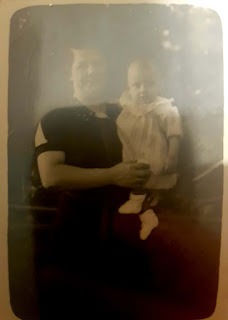
Yehuda Saporta, an only child, was born in 1938, to Buena and Salvador Saporta. They were a secular, Sephardi family living in an apartment on the second floor on Halatini Street, Salonika, in the north of Greece. They spoke Greek at home. Yehuda had a quiet, lonely childhood, and was home educated by his mother instead of going to kindergarten. When he was supposed to begin school, the war started. He did not have any friends nor did he play outside, therefore he does not know the area well.
Yehuda's father, Salvador had seven siblings- Albert, Pepo, Izak,Lucy, Ida, Matilda.He owned a haberdashery shop called “Bazar Palestina”. Two Zionist movement groups "Zionei Maccabi” and “Max Nordau" and a group of Jewish seamstresses used to hold their meeting there. Yehuda's mother, Buena had one brother named Harry, who was married and had one child, David. Unfortunately,the uncle’s family were all murdered during the Holocaust.
Yehuda's family had had a Spanish passport (they had papers proving their relation to the Alhambra Decree), therefore, they were one of the last to stay in Salonika.

On July 27th 1943, the 367 Sephardic remaining in Salonika had arrived at the Baron Hirsh Ghetto and were sent to Bergen -Belsen by a train on August 2nd 1943.
From that moment, Yeudah and his family began to speak Ladino, because the other Sephardic Jews spoke it.
The ride took 11 days (mostly at night). While they were crossing Germany, aircrafts were bombing the area. During one of the bombings near Nuremberg on August 10th, the German soldiers fled and left them locked in the train.
At the end of August 1943, They reached a small camp in Bergen-Belsen and were not forced to work. There was a roll call every day, they were neither tattooed nor dressed in prison garb. They felt awfully uncertain. The winter of 1944 was terribly cold. They spent most of their time in camp in the barracks wrapped in blankets and would come out only on days when there was no snow.
Men and women were separated in camp, so Yehuda spent most of his time with his mother in the women's barrack. Yehuda’s father stayed in the men’s barrack. As a result of Consul Radglas efforts mentioned above, the Spaniards accepted the whole group of Sephardic Jews from Salonika on February 9th 1944. They were the largest group liberated from a labor camp during the war.
The Journey to Palestine
After leaving the camp in February 1944, they boarded a train to Spain. They entered Spain at the French border at the “Portbou” station on February 13th, where they were welcomed and cared for by the Joint Distribution Committee.
Right after that, they boarded a train for Barcelona on February 14th, where the Joint then put them into different hotels. Yehuda and his parents were sent to a small hotel called "Iberika",where they recuperated, and the Joint gave them pocket money so that they could acclimate The group stayed in Barcelona for only four months because the Spanish government didn’t let them stay there longer. They left Barcelona on June 19th.
Next, they moved to Cadis in southern Spain, and boarded a ship to Casablanca-Morocco on June 23rd, were they were housed in an American army camp called “ Marshall Liuta”’ where many spent their time writing poems about camp life. The little children played with the American soldiers. Madame Eli, a teacher in Salonika, opened a French classroom for the children. That was the first time Yehuda attended school. The group started talking about moving to Palestine, which most of the group eventually did. when?
They left Casablanca on October 13th and started their journey on a train to Oran, Algeria, they arrived there on October 16th and stayed in a camp called “Philperble” for a day. Next, they took a ship to Naples and bordered a train to a British camp named “Yransit” and arrived there on October 20th. They bordered a ship to Port Said, Egypt on October 22nd and arrived on October 27th, where trucks awaited them. They travelled all night crossing the Sinai desert until they reached Gaza on October 28th. The British officials in Gaza did not allow them to enter Palestine and interned them in the "Nuseirat" camp, which was a military prison during the British Mendate. They lived in tin shacks under harsh conditions, and were often attacked by the Arabs. They stayed in Gaza for two months, until they were allowed to enter the country on December 10th 1944.
The journey (map)
In Palestine
When the group entered Palestine, in December 1944 they were housed in the immigrants' home on "Aliya" Street in Tel Aviv. The place was too small to accommodate the entire group, so those who had relatives left quickly. Yehuda's family had no family or friends in Israel, so they had to stay there. Yehuda and his family ate in a kitchen run by an association of Greek Jews for Holocaust survivors on the corner of "Aliyah" and "Chlenov" streets.
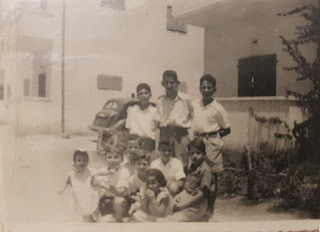
The "Haganah" ‘found’ accomodations for some new immigrants, including Yehuda’s family and three others, in a card club on “Hess “ Street in Tel Aviv.
Unfortunately, the next morning, policemen removed them from the premises and filed criminal charges against them. As in all such cases at the time, the owners of the premises had the responsibility of taking care of the families that had been housed there. So Yehuda’s family received a very small room at the "Eden" Hotel in Tel Aviv.
Due to the small size of the room, Yehuda and his parents could not live in it, so Yehuda moved to an "Aliyat Hanoar" institution in Haifa.
During his stay there, he found it difficult to communicate with the people around him because he did not know Hebrew and this was the first time in his life being alone, without his parents. After a year and a half, his parents managed to buy a house in the Greek immigrant housing project in the "Yad Eliahu" neighborhood of Tel Aviv, where he began to study at "Bialik elementary School". From there, continued to study at the "Max Payne" School and studied to be a radio technician.

Yehuda joined the army as a wireless technician in the Teleprocessing Corps. As a part of his service, he returned to the "Nasrat" camp where he had stayed before entering the country. After completing his service in February 1959, he served as a civilian employee of the IDF for four years.
Yehuda married his wife, of blessed memory, also of Greek origin and lived in Ramat Gan. At the same time, he left his job as a civilian employee of the Israel Defense Forces and eventually started working at IAI , and stayed there for about 30 years. In 1981 he moved to Kfar Sava, where his two children were raised.
Family in Israel
Yehuda became a widow 30 years ago and lost his eldest son 10 years ago. He has an 8-year-old granddaughter, Talya, his youngest son’s daughter.
Today
A few years ago Yehuda went on an organized tour to Salonika, recalling a few places in his past. Yehuda is a member of the Executive Committee in the Salonika Heritage Center of Greece in Petah Tikva where survivors tell their life stories. Many schools visit the center where they learn about Greek Jewry. Yehuda also participated in the Theater Testimony program. He spends his free time attending courses at “Bar-Ilan” University.

