


Shaul Ben Tora
RelatioNetSHBE30MIIT
Shaul Ben Tora
Last Name: Ben Tora
.First Name: Shaul
Father's Name: Luigi
Mother's Name: Anna
Date Of Birth: 21.1.1930
Place Of Birth: Milan
Current address: Kfar Saba - Bait-BaKfar.
Places:
Before The War:
Italy (Rome, Venice, Milan, Firenze), Switzerland
During The War:
Milan, Piza, Canto, Abbiate Guazzone
After The War:
Firenze, Palestine
Background Information
The Jews of Italy
Jews have lived in Italy since the days of the second temple.
Until the 15th century, most of the Jews in Italy lived in the south, and in 1500 some started to immigrate to the north.
In 1516, the first Jewish Ghetto was founded in Firenze, and later in Rome and in other cities in Italy.
In 1870, as a result of the french revolution and the french conquests, the Jews had the same rights as the other Italians, and in 1870 the emancipation in Italy succeeded.
The facicst government, led by Mussolini, rose to power in 1922, and in 1938 the race laws were published.
As long as Italy remained an alley of Germany and not under Nazi rule (1939-1943), Hitler didn’t require exiling nor killing the Italian Jews. Mussolini himself did not agree to exile the Jews, and one of the reasons for this was that he wanted to show Germany his independence.
But when the fascist government descended from power, many Jewish families were forced to leave their houses in the years 1941 - 1943. They moved to small villages in the mountains until Italy was liberated at the end of April 1945.
In September 1943, the Nazis invaded Italy and the Social republic was founded. The Social Republic was a government founded by Mussolini, under the patronage of the Nazis in northern Italy, after he lost his control over Italy. After Italy was conquered by the Nazis, Hitler decided that the Jews of Italy should also be exiled and killed like the rest of the Jews under Nazi law, and the republic agreed agreed with this policy.
Out of 44,500 Jews that lived in Italy before world war II and the holocaust, at least 7,682 were killed.
The Jews of Milan
In 1928 the number of Jews who lived in Milan was 4,500. In the 30s of the 21th century the size of the Jewish population in Milan increased to 8,000 Jews, due to the escape of Jews from Nazi Germany to Italy. In 1938 there was another great migration of Jews to Milan, this time form small villages all over Italy. They came to Milan because of the Nazi race laws in Italy. They hoped to find shelter during those hard times with the Jewish community of Milan, which was very strong and influential among the Jewish institutions in Italy.
On december 1st 1943, The Nazis started an operation of gathering and exiling the Jews of Milan. The Italian police and civilian informants also took part in this operation, and even though a lot of Jews found a way to escape, 850 Jews out of the two thousand Jews of Milan were caught and exiled. 816 Jews from Milan were sent to several concentration camps such as Auschwitz-Birkenau, Bergen-Belsen and Mauthausen in 14 transports. Some of the stransports took them straight to the concentration camps and some of them stopped first at concentration camps in Italy. Out of the 816 Jews only 26 survived.
(Wikipedia)
The Jews of Rome
The Jews of Rome thought that because the Vatican city was in Rome, they would be protected and that’s why most of them didn’t abandon their houses. In October 1943, Eichmann gave Theodor Dannecker (an SS captain) the permission to exile all the Jews from Rome. Special units from Germany divided Rome into 26 areas, located the houses where Jews lived (they were given specific addresses) and imprisoned them.
The Catholic Church helped the Jews find a shelter (presumably by the order of the Pope). 1259 Jews were caught, but the pope convinced the police to free children of intermarriages. As a result, only 1004 Jews were sent to Auschwitz-Birkenau. Later, more Jews were hunted down and sent to concentration camps. Additionally, 300 Jews and Christian citizens were killed on March 25th, 1944 as punishment for Italian partisans killing German soldiers.
After the war only 13 men and a single woman returned to Rome.
(Wikipedia)
The Jews of Pisa
In the 20th century young Jews from Pisa joined the Fascist party. This association came to an end on July 12th 1938, when the “Race Laws” were published. During the war, Pisa was led by a Jewish Mayor, who was also the head of the Jewish community. On august 1st 1944 he was murdered. During the Holocaust 12 Jews were sent to concentration camps and another 8 were exiled.
(Beit HaTfutsot and Wikipedia)
The Jews of Venice
The earliest documents linking Venice with Jews dates back to 945, when the Senate of Venice prohibited captains who sailed to and from the far east, to take Jews on board their ships.
The Jewish quarter of Venice was first mentioned in 1090.
After the 13th century, the imigration of Jews to Venice began. They weren't allowed to live in the city and instead lived on the nearby island “Spinalonga”.In 1366 Jews were allowed to live in the city for a while, but after a few years they had to leave again to the island due to a dispute with the Christians. By this time, the Jews were required to wear a yellow star, and later a yellow or red hat.Following the exile of Jews from Spain (1492) and from Portugal (1497), many Jewish refugees came to Venice.
Over the years, especially in the 15th and 16th centuries, there were many blood libels and the Jews lived in Ghettos. Since the Jews were very important to commerce they were not exiled.By the 19th century, the rights of the Jews became equal to the rights of the other citizens. Although the status of the Jews didn't change, the head of the Venice government at this time was Jewish. Before World War II began, around 2000 Jews lived in Venice.In 1943 capture and deportation Jews began, and by that time most of the Jews were aware of their fate. Between 1943-1944, 200 Jews were taken from Venice and killed.
The Jews of Firenze
A formal Jewish community in Firenze was founded in the 15th century. Before that there was only a small amount of Jews who lived in the city during different times.
Most of the Jews in Firenze were doctors, merchants or moneylenders. In 1577 a Jewish Ghetto was built for the Jewish community in Firenze by Prinze Cosimo, and when the French invaded Italy in 1799 the Jews received equal rights.
In 1899 the temple of Rabbinate was transferred from Rome to Firenze, and it became a center of Jewish culture in Italy.
The Jews of Firenze were surprised by the “Race Laws” that were published in 1938. A few years later, in September 1943, the Social Republic was founded in Northern Italy and there was a decree to imprison the Jews of Italy and transport them to the Concentration Camps. In november 1943, 342 jews were exiled, and only 13 of them came back to the city after the war. The persecutions continued constantly until Firenze was liberated by the Allies on August 11th 1944.
These times were hard for the Jews of Firenze, even though most of them weren’t sent to Concentration Camps. They were humiliated and their quality of life decreased.
250 Jews from Firenze were sent to Concentration Camps and most of them were killed. In 1931 there were 2,730 Jews in Firenze, and after the war, in 1945, only 1,600 left.
(wikipedia) + (Beit HaTfutsot)
The Jews of Switzerland
Switzerland has always defined itself as a netural country, including the years of World war II and the Holocaust. In 1938, when the Nazi policy towards the Jews has escalated and hundreds of thousand of jews were exsiled, Switzerland didn’t let Jewish refugees into it’s borders. From the fall of 1940 until April 1942, 420 Jews found shelter in Switzerland. In the summer of 1942 hundreds of Jewish refugees arrived in Switzerland every day, and as a result, the police decided to prohibit migration of refugees into the country. On August 13th 1942, the swiss police decided to banish all refugees, regardless or religion, from entering Switzerland.
(Yad Vashem)
Sources:
Wikipedia
Yad Vashem
Beit HaTfutsot
Shaul’s Story
Before the war

Shaul Ventura was born on January 21st, 1930 in Milan to Anna and Mordechai Luigi Ventura. He has four siblings - His elder sister, Miriam, who was born in 1928, His brother, Daniel, who was born in 1936 and the youngest, Emanuel, who was born in 1938.
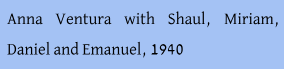

The economic status of the family was good. They could afford a car and vacations in the sea and in the lakes area. Luigi Ventura was born in Piza, Anna was born in Rome and got married in 1927 at the synagogue in Rome. Anna was a teacher in the jewish school in Rome and Luigi was a chemist and helped to develop a radio that was based on galena.
The lifestyle of the family was considered religious in Italy, although the jewish lifetly that was common in Italy was not as observant as the jewish lifestyle in Poland’ for instance. Even though they were

interested in Zionism and read books
about it, they stayed in Italy and didn’t make Aliya. In retrospect, the family children discover that a part of the reason they stayed in Italy was that Anna was pregnant at the time. But staying in Italy wasn’t rare. In general, there were not large numbers of jews that made Aliya. Also, The community was quite small compared to

others in different countries in europe -only thirty thousand people.
In 1934, when Shaul was aged four, The family moved from Milan to” Lido Di Venezia'' (Venice Lido). Shaul remembers he had a jewish friend named Leah at that time. In addition, he didn’t go to first grade because he already knew how to read and write. He started his formal studies in second grade in a local school in Venice Lido, and was not obligated to attend religious classes, as the school was not a jewish one. When he was in third grade he started going to a jewish school in Venice, and was absent most days. The school was very small and he shared his class with only three other students.
Italy was not a particularly anti-sematic country. There was a general hatred from the church but it wasn’t as deep as the hatred in Poland or Germany, and as a result, the jews didn’t think that what happens to jews in Poland and Germany will happen to them, in Italy. The italian pope won’t let anything like that happen, they thought, and Italy has a constitution that protects the Jews. The italian Jews loved Italy and when they received the emancipation in the 19th century they blossomed right away - they were proud to be jews who loved Italy.
In 1938, when Shaul was in the fourth grade, the family moved to Rome because of Luigi’s position, and he went to a school there. He had three friends in that school, and the son of one of them even married his daughter.
Despite the optimism of the italian jews, the race laws were published in Italy in 1938. Much like Germany, jews were slowly forbidden to do more and more things - children were banished from schools, non-jews were not allowed to marry jews or have sexual relationships with them, jews were not allowed to own a phone nor a radio or be involved in christian business deals. As a result, Luigi was banished from his positions, although he received a French knighthood for his loyal work as a chemistry professor in the Rome academy.
He tried his luck in Switzerland, where he tried to find a different job.Shaul knew some french from his parents and the things that were most memorable for him from this time is the fine quality of paper in switzerland compared to the Italian paper, and the face that in switzerland, unlike Italy, cursive was customary (and a result he writes like that to this day).
Another significant thing he remembers is that for the first time in his lifes he witnessed an election and learned what democracy is, because Italy was faciast.
Unfortunately, Luigi didn't get a work permit because there were too many refugees and as a result, after four months in Switzerland, the family separated.Anna and her children went back to Italy and roamed from one place to another. Shaul finished fifth grade in Livorno, Italy, and went to sixth grade in a middle school in Rome. Luigi went to France, to seek a job. He worked in a plains factory and prepared for the family arrival - he was organizing a place to live and everything the family would need in order to have a good life in France as the second world war started.
During the war
In summer 1940, the Germans almost got to Paris while Luigi was there, and he, in the same way as other french jews did escape, mirically escaped from Paris to Italy. Only by riding his bikes, he cycled to Bordo, and when the Germans got there too, he went to Nice, where italian soldiers agreed to let hip pass the border back to Italy. He cycled a total of twenty-thousand kilometers and arrived at a small village near Milan where the family were, they finally reunited. Anna’s mother, Julia was also present. They were quite safe in Italy because there weren’t Germans in Italy, only Italians, and there weren’t concentration camps yet.

Shaul went to seventh grade in a jewish school in Milan, but in 1941 the bombs on Milan got worse, and as a result the family moved to Mariano Comense (an area between Milan and the lakes). At first, Shaul used to go to Milan by train, but after four months he left the school. As a result of the family’s frequent transitions, he didn’t make a lot of friends and spent most of his time reading. In these times, the first years of the war, Shaul and his family were not afraid from the consequences of them being jewish, and escaped only from the bombs.
A short while after the S.S troops arrived in Rome, in 1942, the first acacia took place. People were taken from the streets and loaded them on trucks. The s.s soldiers with the help of informers managed to catch a thousand jews. The Ventura family didn’t know about this acacia in Rome, because jews were not allowed to own a telephone or a radio and it wasn’t published in the newspaper, of course.

Shaul had a fake identity card. Due to the fact that Shaul’s father was a chemist, he managed to erase the category where it was written that he was a jew. If someone looked closely, he could notice the erasure but no one noticed it. This identity card helped Shaul in situations where Germans were involved, mostly because they trusted the signature from Milan. But there were situations where the identity card did ot help. As mentioned, people were arrested and loaded on trucks to forced labor. One time, Shaul got arrested and almost loaded on the truck. Luckily, his sister, Miriam, started a scandal and yelled at the soldier: “Don”t you see he’s still a child?!” and people joined her yells and shouted. Eventually, the German let him free and he was saved.

In 1943, Italy retired (??) from world war II, and the king escaped what caused chaos in italy. A facist government was established and it gave an order to prison all the italian jews. As a result, Anna got arrested. The family lived in (??) at the time, a village near Milan and they discovered from the newspaper that they should extradite themselves to the police. They, Luigi, Anna, the children and Julia, decided to escape and move from one side of the street to the other. On the other side of the street lived a family of carpenters that welcomed them to their house and were willing to help them. A while after they moved in, on December 2nd, 1943, Julia didn’t feel well and Anna went to their old house in order to bring medicines. While she was crossing the road she was caught and got arrested. That happened most probably with the help of indormers that wanted to take the hours for themselves. She was sent to a prison in Milan and from there to Fossoli concentration camp.
Since Anna was arrested the family hided and started to escape from one place to the other and Shaul’s grandmother, Julia, didn’t want to be a burden and hided in a house of a fasict woman, who was loyal to Mussolini and didn’t accept the fact that the jews were suddenly abhorred.
Julia felt guilty about Anna’s arrest, and when she discovered that she was in Fossoli concentration camp, she went there and asked to come in. Three days she was trying to convince the officers to let her in as they were telling her to go away. She was stubborn and managed to get through the officers and enter the camp. In the camp she met the camp’s manager, who was a former student of her, and she explained that she came to meet her daughter. He was probably very surprised to see her, but he managed to organize her a small room, a mattress and blankets in order for her to be more comfortable. She died in the camp from illness and weakness. On february 22th Anna was sent from Fossoli to Auschwitz and there she was murdered , aged 44.
The family succeeded to stay in touch with Anna and Julia via letters,eighteen of them in total. They were able to exchange letters probably due to the help from the local priest. Among the last letters, there is a latter that was written by Anna - years later it was clear she was saying goodbye to each one of the children. The letter was sent from the train’s wagon from a town near the border, and she asked someone to take it and send it to her family. She wrote that she is doing very good and that they will meet again soon. She was trying to cheer up her children even though she knew where she was being transported.
Luigi and the children escaped from place to place, and even tried to escape to Switzerland. At first, Shaul, his father and Daniel tried to escape with the help of a smuggler. But they suspected him and tried to cross the boarded through the woods, but the facist troops caught them and took them to tha police station. In that time, Miriam and Emanuel were still hiding in their hiding place. Fortunately, the officers let them go. Nevertheless, Luigi suspected it was a trap and decided to stay there while Daniel and Shaul fled to Piza. Throughout these days of escape, Shaul and his brother were trembling, afraid their father might not come after them. But he did - and the family was reunited. Despite the happiness about being together again - these times were hard. They had no food except a little rice, they only had a few clothing items, almost no money, and the worst - Anna was not there. One of their hiding places was in a small house on the beach in “Porto Di Pisa'' (Marina Di Pisa).
The family escaped from Milan to Pisa because Luigi, who was born in Pisa, Though he might find acquaintances and friends who would help them. Luigi got a permit to go up north in order to bring back medicines for the hospital in pisa. He got this permit because, as mentioned, he was a chemist and a pharmacist. Its was very dangerous to go by train because of the frequent bombings. Nevertheless, he still traveled by train because that was his way to earn money. Shaul went with Luigi on these road trips - from Pisa to the north and back, carrying suitcases full of medicines. Luigi went to the north ten times, but luckily, Shalu came with him only nine times. On the tenth journey to the north, Luigi got killed during a bombing, nearby Pisa.
After both of their parents were not among the living, the children were all alone, and Miriam took care of her three young brothers. It was even written in the letter Anna sent them: “Do as Miriam says,” she wrote. At sixteen, Miriam became a young mother, and as a child Shaul admired very much for her special measures.
In 1944, there was a difficult pursuit after jews, unlike the year before, and the origin of the four children became more meaningful than ever. Nevertheless, the situation in Italy was hard not only for the jews but also for non-jews who lived there. Everybody escaped from the bombings and theredor the hid as though they were only escaping from the fire and not as jews that were escaping from their chaseres. In those times, each man was for himself.Right after Luigi died, the Germans announced a fortification in the beach area the four children were, so they started to escape from place to place again, until they arrived in a hospital in Pisa. Finally, the awaited turning point has come - Pisa was liberated in August, 1944.
After the war
Italy, like other countries in Europe, was a center of which jews made Aliyah from. The jews that wanted to make Aliyah had an organization that was called “Ha Bchira” (The choice) and then the people of the jewish brigade helped them make the Aliyah.
When pisa was liberated the children were found by israeli soldiers that served in the british army. At first, Shaul thought they were water transporters (because the water in the tap water in Italy was infected), but then he saw the David star on their uniform, and realized they were jewish. He told the only word he knew in hebrew “Shalom” - and they embraced him. They offered Shaul and his brothers to move to a training youth house (“Hachshara”), and they agreed. After several months, in January 1945, Emanuel got very ill, unfortunately, and passed away. During the “Hachshara” Shaul had several jobs, and Daniel and the other young children in this “Hachshara” went to a jewish school that was run by the jewish community and jewish soldiers. Surprisingly, Mirella, who was in this “Hachshara”, is the sister of his wife today. In addition, in the youth house the “Hachshara” members were told about Israel and the socialist lifestyle in the Kibbutz, and they even saw some pictures. The three siblings were in that youth house only for a few months until they got Immigration Certificates and made their Aliyah in March 1945.

When they got their Immigration Certificates, Shaul, Miriam and Daniel began their journey to Israel. The long journey started with a train ride, a ride that was a month long and it’s path went through Firenze, Rome until it arrived in the port.The train was a goods train because the war hasn’t ended in that time, and as a result of the army not having a lot of trains it stopped frequently, and therefore it took the jews a lot of time to arrive in the port, as mentioned. The passengers had to wait in the middle of a field, hours st times, and nevertheless they felt safe. They had food and everything

they needed and also a great happiness - unlike the trains that went to Auschwitz, their train was on its way to the promised land - their new home.
Shaul and Yaara met on the train. He was a teenager and she was an eleven year old girl. Shaul liked her and they became close friends during the days on the train from Firenze to the port. Not only they became close friends but also Shaul courted her - he taught her how to find the north star and what are the differences between the accents of people from north and south Italy.

After a month and a half, the three siblings arrived in the port and went on a ship called “Princess Cathrine” (Princess “Cateline” in italian). The sale was one week long, and at the end of it they were finally in Israel. On the ship, Shaul volunteered to work in the kitchen because he was one of a small number of passengers who were not seasick.
When they got off the ship they felt safe, after all these years of escaping and hiding. The three young adults that were left from their family were sent to a camp in Atlit and then they had to separate because of their age differences. Nonetheless, they managed to stay in touch with one another. Miriam was sent to Degania, Daniel to a youth house in Motza and Shaul to Mikve-Israel - an organization that received youth that made Aliyah. In these times the youth was separated into two sectors - religious and non-religious. The decision to which sector the teen would be sent to, they asked the girls one question - Did your mother used to light Shabbat candles? The girls, who were afraid from the shared showers, said yes - and so did the boys. Shaul was one of fifteen members he shared his group with, among them Mirella, Yaara’s sister. The members of the group, that came from different countries in Europe, had an immediate connection. Additionally, they were not allowed to speak in their mother tongue, therefore they had to learn how to speak hebrew. Shaul went to school in Mikve-Israel for four hours each day and worked for the same amount of hours after that.

After a year and a half, Shaul left Mikve-Israel because he didn’t want to live in the religious lifestyle that was required there, and went to a youth training in “Ramat Yohanan”. When the Palestaine war started, in 1947, Shaul and his friends from Ramat Yohanan were required to go to the south (“The Negev''). They arrived at

Gevim Kibbutz, and lived there during the years of the war, including the siege.
Throughout the years Shaul and Yaara stayed in touch with each other, mostly through Yaara’s sister, Mirella, who was at the same training Shaul was in Mikve-Israel. Six years after they met, in 1951, Shaul and Yaara got married in Kibbutz Gevim. Shaul was 21 and Yaara was 17. They lived several years in the Kibbutz and their first daughter was born there, in 1953 but didn’t get along with the socialist lifestyle and left. Shaul found a job as an agriculture teacher in Afula, and the family moved to Afula. In Afula he met a school manager that decided to found an elementary school and was looking for agriculture teachers. That manager invited Shaul to work in that school, and that’s how he became an agriculture teacher, which was only the beginning. In future years, he would teach biology, bible studies and history. In addition, in the 60s, he was a manager of a youth institution for children with learning disabilities for ten years.

Shaul’s original family name, Ventura, was officially changed to Ben-Tora in 1949. According to his family tradition that passed from one generation to the next, the name Ben-Tora was given to a jew lived in Spain, and throughout the years the name slowly became Ventura. Shaul decided to express the fundamental

change in his family with it’s Aliyah and the establishment of Israel in 1948. When the resident registrar arrived at Kibbutz Gevim in order to give the citizens an identity card, Shaul said that his last name is Ben-Tora, and that was what he wrote.
Today, Shaul and Yaara live in Bait-BaKfar in Kfar Saba, and they have four children, ten grandson and -granddaughteres and five great-grandson and great-granddaughteres All the family documents from the years of the holocaust are in Yad-VaShem. Before Shaul became the main documentero of his family’s story, his sister, Miriam, was the one who took care of the family legacy. She used to gather all the family members on the grass, and they would share stories together.After she died, in 1992, Shaul got her role. These days he continues to write everything he remembers and share the unique story of his family.


