


Michelin (Mimi) Mises
Relationet Project – Saar London and Tal Roup
June 7th 2019
Full name: Michelin (Mimi) Mises
Number of the blog: RelatioNetMIMI41PAFR
Our names: Tal Roup and Saar London
Our Emails: talroup@gmail.com , saarlondon@gmail.com
Family Name: Mises
Father's name: Charles Mises
Mother's name: Terres Mises / Popover`
Sister's name: Rozin Martin
Date of birth: 27.10.1941
Place of birth: Paris, France
Place of residence (before and after the war): Paris, France, 11th arrondissement, rue Folie Mericourt 108.
Town during the Holocaust: Paris & Lyon, France
Where she lived in Israel: Ramat Gan, Kfar Sava
Current address: Emek Iron 10, Kfar Sava, Israel
Holocaust in France
Before the war:
According to ancient Roman sources, the history of the Jews in France began when two kings of the Land of Judah, belonging to the Jewish people Arcelos and Herod-Antipas, were exiled to Galia (France in the Middle Ages). From that time on into modern times the Jews have suffered periods of anti –Semitism, exile and rebirth. During the Renaissance, once again conditions the Jews lived under improved and they prospered both culturally and economically eventually receiving civil rights. This period ended abruptly during the Dryfuss Trial when France became very anti-Semitic. Many Jews fought for France in World War I. By the interwar period Metropolitan France had a population of about 150,000 Jews. In addition, France hosted a large population of foreign Jews who had fled persecutions in Germany. By 1939, the Jewish population had increased to 330,000. After the occupation of Belgium and the Netherlands in 1940, France hosted a new wave of Jewish immigrants and Jewish population peaked at 340,000 individuals.
During the war:
The Holocaust in France refers to the persecution, deportation, and annihilation of Jews between 1940 and 1944 in occupied France.
France was occupied in May 1940 by the Germans and was divided into two parts: The North-Western side under the German authorities, and the South-Eastern side as an independent country- Vichy government that collaborated with the Nazis.
The persecution began in 1940 in both parts of France, thousands of immigrants, Jewish men and women with no children, who had German citizenship or were of German descent were concentrated in the “Winter Stadium” (Vel' d’Hiv) in Paris. This was conducted by the Vichy regime under the orders of the Nazis.
In July 1940 the Vichy regime passed a law calling for the reexamination of the citizenship status of immigrants. The main victims of this statute were Jews. Synagogues were ordered to turn over the lists of their members to the French authorities while Jewish businesses were marked with signs in French and German, indicating their Jewish ownership. Many Jewish shopkeepers hung their medals of honor for service in the French Army during the First World War, next to these signs, in an attempt to emphasize their loyalty to France.
In October 1940 the Vichy regime published a “Jewish Statute” which revoked the citizenship of all French Jews, who were stripped of their property, fired from the Civil Service, and forced to close their businesses. Tens of thousands of businesses and thousands of apartments were taken from the Jews. The medical licenses of Jewish doctors were taken from them, and they were forbidden to practice.
In the winter of 1940-1941 the Germans and the French sent tens of thousands of Jews to detainment camps in the south of France, most of who were refugees and immigrants. These camps had claimed the lives of some 3,000 Jews, the first victims of the Holocaust in France. This is a rare case in the history of the Holocaust, in which Jews were sent to concentration camps in Western Europe, and not in the East. One of these camps was called Camp de Rivesaltes. It was organized so that men and women lived separately, so many families were separated. Conditions in the camp were subhuman in terms of clothing, food, housing, and health, which led to a high mortality rate among its inhabitants.
In May 1941 the German government arrested all the Jews in Vichy France with the help of the local police. French Vichy government and the French police participated in the roundup of Jews. The deportations culminated when Jews from both parts of France were transferred to concentration camps in Germany and Nazi-occupied Poland from 1942 when 2,313 Jews were sent to Auschwitz to be exterminated in a number of transports. This continued till August 1944 when the Allies invaded the coast of Normandy in Northern France and Paris was liberated. By the end of that year almost all of France was free.
Lyon:
The city of Lyon is in the center of eastern France. During World War II, 5,000 Jews lived in Lyon, most of who were murdered during the Holocaust. The city was the center of the underground resistance movement in France and many of the Jewish partisans operated in the city during the war.
Results:
Of the 340,000 Jews living in France in 1940, more than 75,000 were deported to death camps, where about 72,500 were killed. Although most deported Jews died, the survival rate of the Jewish population in France was up to 75% which is one of the highest survival rates in Europe.
Jews in France today:
France has the largest Jewish population in Europe and the third largest Jewish population in the world. The Jewish community in France is approximately 600,000.
In 2009, France's highest court, the council of state ruled in favor of recognizing the state's responsibility in the deportation of Jews during World War II.
The Jewish community has integrated into society and the economy. In 2013 there were 13 Jewish members of the parliament out of 925. However, it deals with two major problems, assimilation on the one hand and anti-Semitism on the other, which exists in France beyond the norm in other Western countries.
Mimi's family - before the war:

Mimi's father, Charles Mises, (1912 – 1965). left Poland with his brother and moved to Paris. The rest of his family remained in Poland and perished during the Holocaust.
Mimi's mother, Terres’, (April 28th 1922 – 2016) family, parents and younger brother, emigrated from Warsaw to Paris in 1922.
Terres’ was a seamstress and Charles was a tailor. They worked at their craft their entire lives. Her family was wealthy in the early 1930's, especially her grandparents - Shmuel and Rohale.
Mimi's parents met when her father started working for her mother's father- Shmuel. They lived in her grandparents' large apartment in Paris in Folie Mericourt Street ,108, which was also their work shop.
Her parents married in November, 1940 as Germany occupied France.
During the war:
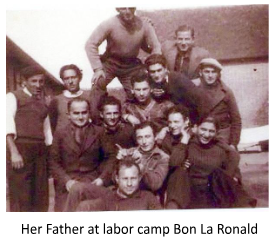
The atmosphere was tense due to the many sanctions on the Jews in Paris. Mimi's father was taken to a labor camp called Bon La Ronald on May 14, 1941 while Terres was pregnant with her. He worked in a farm from July until April 28, 1942 (Terres' birthday!). Charles fled from the labor camp and went back to their home in Paris, where Terres and Mimi were still living. Terres was stunned when she saw him. The next day he had to run away early in the morning because he knew the Germans would come looking for him. He left Terres and Mimi and told them he was going to Lyon. After he had fled, policemen came to their house and searched for him.
In the summer of 1942, Terres and Mimi tried to get to Vichy controlled France by bus. During the ride the bus was stopped by the Gestapo and they caught a Jewish woman who had no documents. However, they did not catch Terres and Mimi. The Jewish woman who knew about Terres's identity informed the Gestapo of Terres's Jewish identity. As a result, Mimi and her mother were taken to a concentration camp on the French / Spanish border called Camp de Rivesaltes. It was located in the south of France, near Perpignan which was in the Vichy regime.
Terres met a young woman and bought her a cup of coffee on the way to the camp since the young girl had no money. She wanted to tell Terres about her real identity but Terres didn’t want to listen so she wouldn’t have to hide any more information. The young girl later 'worked' for the camp commandant.
They were imprisoned in the camp for three to four months. Mimi was eight months old and caught Dysentery making her underweight throughout their internment.
Terres pretended to be a nurse in the camp so she could take care of her sick daughter.
In order to free Terres and Mimi from the camp, they used the friendship with Leon, a friend of Mimi's father after these four months. Leon had a relationship with a Christian girl who worked at the City Hall and managed to obtain permits to leave for Mimi and her mother thanks to her work.
The young girl Terres had met before felt a sense of commitment to Terres because she had bought her coffee. In order to accelerate the process of her release, she spoke to the camp commander. The commander helped them by putting the letter they had received in a pile of letters for release requests from the camp. He made sure to pass on the letter without people knowing that she was Jewish. A few days before the selection for the extermination camp, the letter was signed for their release. The sound of the stamp that confirmed liberation was engraved in Terres' memory until the day she died. Some of the difficulties they faced on their way, were traveling in foreign vehicles during curfew hours and a long ride on the train. Terres and Mimi arrived to Lyon where they lived until the end of the war.
Life in Lyon:
As they arrived in Lyon, in 1943, Terres met Charles again in Lyon, France.
In Lyon there was a shortage of food. Her parents did not walk together in the street in order to reduce the chances of both of them getting caught. Her father had found work in Lyon as a tailor. When he got to his new job, his manager discovered that his papers were forged. He decided to help Charles and forged new and more reliable documents for him.
They lived in Lyon for about two years, her parents worked there as tailors in order to earn some money until American soldiers entered the city and the war ended in 1944.
After the war:
Mimi's parents wanted to return to their former home in Paris at the end of the war, when Mimi was about 4 years old. However, another family was already living there. The family in the apartment agreed to vacate the apartment only when their original apartment will be available. Their apartment quickly became available and Mimi's family returned to live in the apartment they had lived in before the war in Folie Mericourt street 108.
Mimi's parents had to work many hours of the day when they returned to Paris. As a result, they had to move Mimi to a village named Prunuer to a foster family to take care of her. The foster family took care of Mimi and provided her food and a caring home. Mimi's parents would visit her in the village Prunuer (which was relatively far from Paris) once a week, yet they never came together. According to Mimi, the week she did not see her parents felt like a month and she was sure for years later that she saw her parents once a month and not once a week. This separation from her parents at such an early age left her in a state of trauma to this day.
Mimi returned to her parents when she was 5 years old to their original home in Paris. Her parents' main focus was work at the time.
Mimi's mother told her that they were Jews only when she was 12. She felt helpless because she knew nothing about Judaism and what had happened to them in the Holocaust. From that moment on, Mimi never stopped reading books related to Judaism and Jewish life.
They would not talk about the Holocaust or the war in Mimi's house. There was an atmosphere of humor even though many of Charles' family and Terres' family had perished.
Mimi was part of the youth movement in Paris at the age of 16-17. It was where she first met Theo, her current husband.
Mimi was looking for work in Paris at the end of the 1950s. The place of the work she wanted, refused to hire her because she was Jewish. After that, she worked at an airline company, she encountered abusive and insulting responses of Jews and the State of Israel.
Mimi visited Israel for the first time at the age of 20, for two months. She started to know the country, and met her first husband, Maurice (who was also French) during the visit.
The couple married in 1963 when Mimi was 22. Maurice immigrated to Israel three years before her because he was a Zionist. He refused to leave the country, so Mimi agreed to immigrate to Israel. She immigrated alone, without her family.
They have three daughters Isabelle, Katya, Natalie and even though they lived in Israel she insisted on speaking only in French to her children.
Mimi never worked until her youngest daughter went to kindergarten. She says that the fear of leaving her daughters at an early age and going to work was related to the trauma she had experienced as a young girl who had been separated from her parents for a long period of time.
When she started working, she worked in a clothing store with her sister-in-law and also majored in arts in Ramat Gan.
Mimi has always loved Israel and as time passed she became more connected to the country and felt proud to live here. She defines Israel as her home and would not have preferred live anywhere else. After a divorce from Maurice, eleven years ago, she met Theo again, the young man whom she met in the youth movement in Paris. They got married a year later to this day.
Mimi says that her mother always made sure to tell Charles's and her’s Holocaust story to the whole family. In general, the legacy and memory of the Holocaust was important to her. Mimi took each of her grandchildren to Yad Vashem after the age of the Mitzvah.
Her Life Today:
Mimi is married to Theo, she has three daughters, seven grandchildren and a great-granddaughter.
She paints and studies art. She likes to travel in Israel and abroad.
A message she would like to convey:
She wants generations to remember the Holocaust, to know what happened, to speak about it and pass the stories on.
Mimi would like the story to be conveyed with an emphasis on maintaining our optimism and continuity as a nation.
At the end of Mimi's first grandson's "Massah Coumta", she was very excited because she considered this event as closure. Her mother stood among the German policemen and now her grandson serves as a soldier in the IDF. All her mother's past was so her eldest grandson could stand with the Israeli flag in the State of Israel which represents the victory of the family.


